
01 · OUTER PANE
6mm solar-control HST toughened
Heat-soak tested toughened safety glass on the weather-facing side, with solar control to help manage heat gain.
OVERHEAD GLAZING RECOMMENDED
Two quotations can both say “double glazed” and “laminated inner pane” while describing very different glass. This is the specification we would start with for our own home.
RECOMMENDED DOUBLE-GLAZED BUILD-UP
Final glass thickness is calculated for the opening, support, location and design loads.
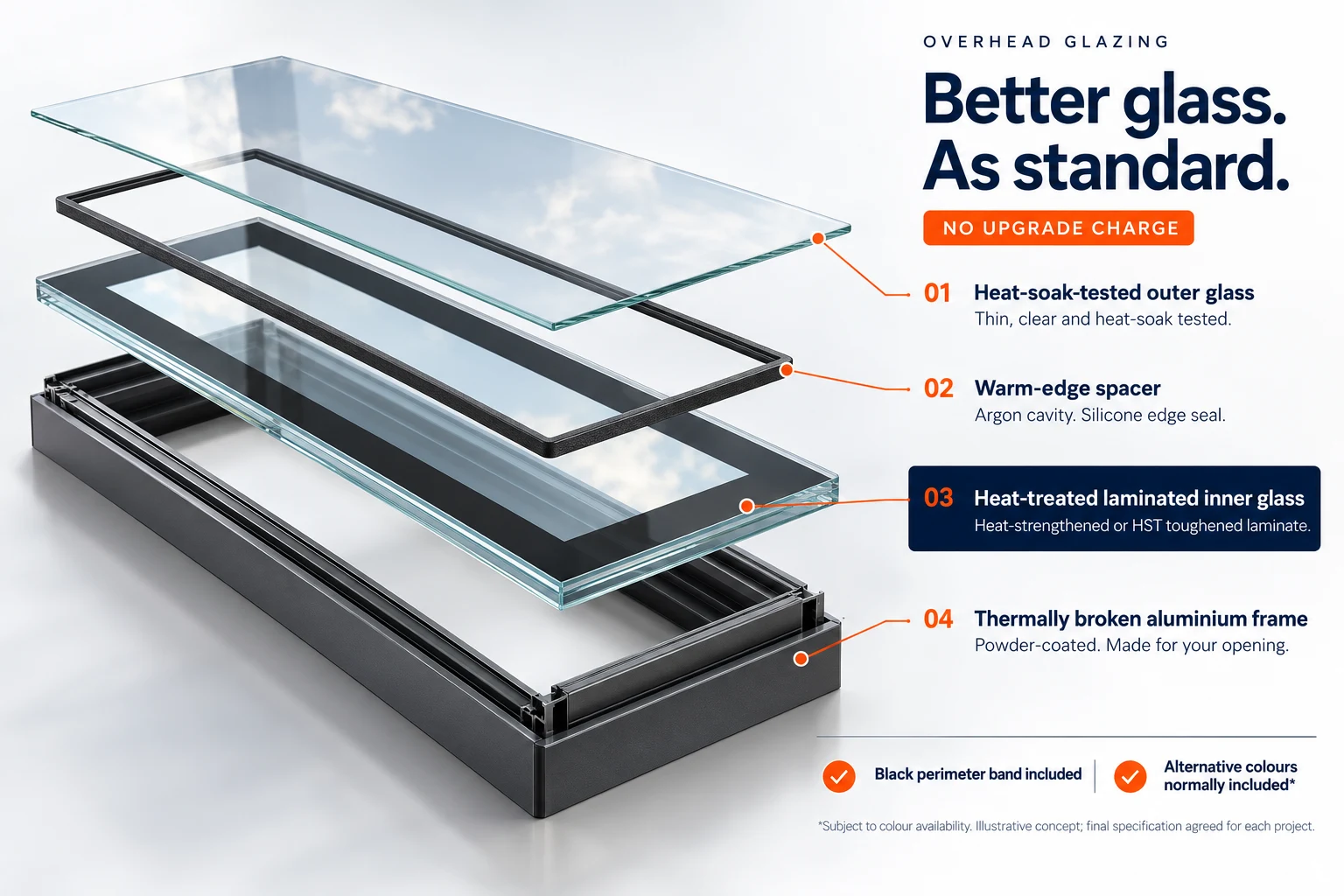
Heat-soak tested toughened safety glass on the weather-facing side, with solar control to help manage heat gain.
A sealed insulated cavity with a warm-edge spacer. The spacer colour and complete edge seal are coordinated with the rooflight system.
Heat-strengthened or heat-soak tested toughened laminated glass, selected around the pane size, support and calculated loads.
A purpose-designed frame supporting the glass edges and fixing to a straight, insulated and properly weathered timber upstand.
THE DETAIL A QUOTATION MAY HIDE
Laminated describes glass plies bonded with an interlayer. It does not tell you how those individual plies were treated before lamination.
Heat treatment: No heat treatment
Two annealed plies bonded by an interlayer. Annealed glass has lower resistance to thermal stress than heat-treated glass.
Our approach: May be selected because it is less expensive to manufacture. Suitability must still be demonstrated for its size, support and temperature exposure.
Heat treatment: Heat strengthened
Greater strength and thermal-stress resistance than equivalent annealed glass. It normally breaks into larger pieces rather than small toughened fragments.
Our approach: Often preferred for suitable maintenance rooflights because the larger bonded pieces tend to interlock and provide better residual stability after breakage.
Heat treatment: Fully toughened and HST
Greater initial strength than equivalent annealed glass. If broken, each toughened ply forms many small fragments retained by the interlayer.
Our approach: Useful where higher initial strength is required, but the fragmented laminate can be more prone to sagging after breakage than a heat-strengthened laminate.
Is the laminated inner pane made from annealed, heat-strengthened or toughened glass?
DESIGN AND SAFETY
Open the topics relevant to your project.
WHY BREAKAGE PATTERN MATTERS
Larger bonded pieces can help a broken laminate retain its shape. The final specification depends on the glass, support and intended loads.
Heat-strengthened glass offers much greater resistance to thermal stress than annealed glass. It also avoids relying on fully toughened glass, reducing exposure to the nickel-sulphide-related spontaneous-breakage risk associated with toughened panes. If a heat-strengthened laminated pane does break, its larger pieces usually remain bonded and interlock within the panel.
That interlocking pattern can help the laminate retain its shape. A fully toughened laminated pane breaks into many small fragments; although the interlayer retains them, the fragmented panel can lose stiffness and sag. This is one reason heat-strengthened laminated glass may be the better choice for a suitable maintenance rooflight.
LOAD DESIGN
A maximum load cannot be taken from “8.8mm laminated” alone. The same glass behaves differently when its dimensions, aspect ratio or support arrangement changes.
Length, width and aspect ratio
Two-sided or four-sided support
Wind, snow and intended use
Horizontal, inclined or vertical
Treatment, laminate and interlayer
Support after a pane has broken
INTERLAYER SELECTION
Used for suitable non-structural rooflight glazing where the complete glass design, edge conditions and application allow.
Selected for structural glass-to-glass designs, commercial walk-on glazing and demanding applications requiring a stiffer structural interlayer.
BEFORE COMPARING PRICES
A lower quotation is not necessarily the same specification at a better price. Use these questions to compare what is actually included.
Based on nine years of rooflight specification, estimating and site-supervision experience, together with more than ten years of specialist glazing experience within the installation team. CSCS and SSSTS qualified.
ROOFLIGHT GLASS FAQS
No. The description does not state whether its individual glass plies are annealed, heat strengthened or fully toughened. Ask for the complete glass build-up.
The interlayer is intended to retain broken glass fragments. For overhead glazing, fragment retention is an important part of the glass safety strategy.
No. Annealed laminated glass uses plies that have not been heat strengthened or fully toughened.
Heat-strengthened glass normally breaks into larger pieces that remain bonded and tend to interlock within the laminate. This can provide better residual stability than fully toughened laminated glass, which breaks into many small fragments that may allow the panel to sag.
No. Capacity also depends on pane dimensions, aspect ratio, support, roof pitch, glass treatment, interlayer, wind, snow and the complete glazing construction.
PVB or EVA may be used for non-structural rooflight glazing. SGP is selected for demanding structural glass-to-glass applications, commercial walk-on glazing and other project-specific structural designs.
No. This is our recommended starting point. Final thicknesses and treatments must be checked against the actual project and approved drawings.
COMPARE THE SPECIFICATION, NOT ONLY THE PRICE
Send us the glass specification and we will explain what has—and has not—been included.